JetStream Racing

JetStream Racing

Tuesday, August 25, 2020

2020 SSS Round the Rocks

Beginning of a New Era

There is not much good that can be said about 2020, it's been a challenging year and one that has required everyone to work outside their comfort zone and think outside the box.  Our normal routines have been upended, but if you look closely there are possibilities for new things to emerge.  In time of uncertainty, you best just play the odds.  We've taken some calculated gambles this year, but before we packed up for the Midwest we had a shot at one last sailboat race in the SF Bay.  The SSS Round the Rocks race is a nice Bay tour that starts us in the Berkley flats, takes us all the way near the South Tower of the Golden Gate, through the picturesque Racoon Straits in Tiburon, gives us a peak into San Pablo Bay as we round The Brothers and finishes up in the Richmond Harbor.

In any other year, one of my regular crew would have flown down to do this race doublehanded, but that wasn't going to happen this year, and further restrictions asked for doublehanded crews to be part of a household or 'social bubble'.   I could always do the race singlehanded, but there was another option.  My 10 yr old son had been lucky to join one of the only summer camps available this year, Encinal YC Sailing Camp.  He spent 4 days a week, for six weeks sailing up and down the Oakland Estuary on a little Opti.  He also joined me as crew for the Wed and Fri night races that started up mid summer in the Estuary.  He has been sailing/racing on board JetStream and Outsider in the Estuary for years, but the Central Bay is a different game.  After explaining to him that it would be a long day in the water, and windy and cold, he didn't hesitate when I asked him to crew for me on the race.

I'll let him tell the rest of the story:

MY AROUND THE ROCKS SAILING REGATTA

It began with a cloudy morning in Alameda, California, where me and my dad were getting prepared for the biggest sailboat race of my life. I was really excited for the race to start.

When me and my dad got out to the bay, it was really windy and wavy, and then I was starting to get a little nervous. But when it got sunny I started to feel better. At that point we were still motoring out to the start. But when my dad was lifting up the mainsail, the halyard broke, but luckily we got the sail up in time.

When it was our starting sequence we started lifting up the jib (the small sail in front of the boat) and I started cranking it in. When our start was at about 30 seconds I started taking deep deep breaths, Then our start was at 20 seconds, 10 seconds, 5,4,3,2,1 and then the start horn went off. We were off to a fine start at about 4th or 5th then started working our way up the fleet slowly. When we rounded the 1st windward mark we were currently in 1st place in our fleet rounding the mark and making our way upwind to the Golden Gate Bridge.

When we rounded Blackaller my dad handed me the tiller. We were moving quickly on the reach and hit a max speed of 19 kts on our way to these two islands called The Brothers. After The Brothers I handed the tiller back to my dad.


When rounding the brothers I thought to myself “almost there Alex, keep up the good work just 2 more legs to go”. The next mark we needed to round was Red Rock, and after that was the finish so this was the time we needed to concentrate, but when I looked back to see if there were any opponent boats, all I saw were some boats that weren't in our division, so that was a relief. Now all we needed to do now was focus and concentrate on rounding the next mark.

We finally rounded Red Rock and the finish was just a few hundred yards away and still no opponent in sight, and I started feeling good I just kept saying to myself almost there Alex, almost there. Then my dad stopped the timer and we finished the race at 2:36:05. But we can’t celebrate yet because we still need to sail all the way back to Alameda in even windier conditions than at the start of the race. When we were done sailing across the bay all we needed to do was sail down the estuary, park our boat at the docks and put the boat away and fix the halyard which would take my dad the rest of the day, as I went home to get warm. The day was complete. When I got home I was really happy and proud of myself, and stuffed myself full of candy.


Still in training, but he turned out to be an excellent crew, and yes, we won our division. That will keep him coming back.


Monday, January 28, 2019

2019 TBF

A happy TBF

Its been a while since we had an enjoyable Three Bridge Fiasco.  The last few years had been a story light or no wind, big currents and frustrating days.  With the bar set so low by the previous years, Rob and I were ready to go at it one more time.  With Rob doing the trek from Seattle just for the race (well and a little surfing on Sunday) the pressure was on to make it a worthwhile trip.   The forecast wasn't exactly encouraging, with a non-traditional NE flow.

We had the usual preparations, a nice meal and some beers to 'finalize' on the strategy.  A strategy that we nevertheless normally ignore by the start of the race.  With the veering of the breeze we were seeing on the wind charts for the day CCW seemed the best direction for us, IF we could make it past TI.  Many TBFs have ended for us by going to TI first, as it can be pretty light there in the mornings.

We made it to the start line with plenty of spare time and began re-strategizing.  With the large majority of the fleet choosing a CW direction, it put our original strategy in question.    We hung around the eastern side of the line to keep an eye on the boats headed to TI, while continuing to monitor the wind line pushing down from the North.  CW, CCW, CW, CCW, with 2 mins to our start, we could see the wind filling in to TI and we made the call to head CCW, as originally planned.

We had a nice close reach up the city front and soon after clearing Pier 39 we deployed the code.  The speedo jumped from 9 knots to 13 and we started reeling boats in.  Clearly we were having way too much fun to appreciate the size of the wind shadow behind Yerba Buena.  Even though we gave it a wide berth by going around the first tower, it was still too close and we ran straight into the vortex from hell.  We also showed everyone behind us where not to go, so the wise ones stayed way clear of us and ghosted around the wind hole around us.   We fought our way through the vortex but at a significant time cost.  We found a southerly behind YB that we rode way East, to get out of the current and trying to hook back up to the main NE flow.  We made that transition much more cleanly and made the Emeryville to Red Rock segment on a single tack.  At one point we tried to redeploy the code but the angle was too tight for us to hold, so we jib reached the rest of the way.  It was encouraging to only encounter boats coming from the other direction only past Richmond.   We were feeling pretty good about our position.  It was hard to see how many boats were in front of us until after we rounded Red Rock.

Next decision was whether to shoot through the straits or go around Angel.  The wind direction was pointing straight through the straits, so there wasn't much discussion.  We started picking up boats ahead of us, but we could still see some pesky little kites ahead.   We kept the pedal down and were able to pick about 10 more boats, but eventually ran out of runway.  We knew the Thompson was ahead of us, I had seen them on the back of YB when we ran into the wind hole, but they clearly had put enough distance ahead that we weren't able to see their finish.  So we ended up in second place for our Sportboats fleet and top 10 overall.   A pleasing day all around.  The big prize was within reach this time, just one bad transition.  We'll be back next year.

Tuesday, September 18, 2018

2018 Big Boat Series

Big Boat Series

by Daniel Forster

It would be fair for you to ask, how can the JS9000 be in the Big Boat Series?  When did a 30' boat with less than a 6' beam become a big boat?  The answer lies in that we are a fast little sportboat and a few other sportboat owners had been lobbying the organizers to create a sportboat division.  They were granted a division last year for the first time, though we didn't participate.  But this year we signed up, with the encouragement and excitement of my 'traditional' crew, Andrew and Rob. 

It would take a few hoops to get us entered.  The majority of the division wanted to race under ORR rating instead of PHRF.  Personally, as long as it provided for competitive racing I was happy with either choice, but I do believe that the ORR rating resulted in tight results.  I also like the fact that ORR allows for multiple ratings based on the course type, which I believe its critical for sportboats, as our downwind speeds can be dramatically higher that our upwind speeds.  After a few rounds with the rating agency, the designer and evening of measurements, we got the rating just two days before the first gun.

Although this year wouldn't be an ideal year for our boat we signed up anyways.  Not ideal because all of the racing would be done with the current flooding into San Francisco Bay.  This means that the upwind legs would be longer and the downwind legs would be shorter.  For the characteristics of the JS we much prefer the reverse, an ebb current into the bay which would make for shorter upwind legs and longer downwind ones.  But that wasn't enough to keep us from racing.  Conditions in SF Bay in September are usually the type of conditions we like with 15 - 25 knots of wind, so as my friend Tom says, "Boogity Boogity Boogity, Lets Go Racing!"

Took a few weekends to prep the boat, elbow grease to buff and polish the hull with multiple applications.  We had a nice new suit of mainsail and jib, and a couple of A2s, and A5 and a Code 0 in our arsenal. 

This is a grueling regatta with 4 days of racing and 7 races in total, with courses around the 15 - 20  mile range.  Though the goal was to have our own sportboat division, some sportboats didn't sign up until the last minute. So instead of racing in a class of 7 similar boats, we got grouped in a 14 boat division with J-111s and J-125s, boats much larger than us.  This would make the starts problematic for us.

Day 1

Race 1 (10th)

Not a good start, literally.  Breeze filled in early for our first start.  It was already blowing around 12 -15 knots with a forecast calling to build up during the day.  It was the first start and though I set up for a conservative start, but I set up too early near the boat end.  I had some room to leeward and tried to close the gap when another boat tried to come in and hook us, but to avoid risking going over early and giving up all my leeward room I came up too early and allowed the trailing boat in.  Now I was trapped between a 40 footer to windward and a boat right on my leeward hip.  With everybody pushing hard, I thought we were all over the line early.  In the mayhem the boat that hooked us last minute call a protest on us for not giving them room (which I thought was aggressive and premature).  I was pretty sure we had been over early and in the chaos we couldn't hear what boats the RC called back.  So we started the first race with a return to the start line and taking a penalty.  Not the way to start a regatta.  Nevertheless, we worked hard on our boat speed and tried to be smart about our strategy around the course.  But being the slowest boat (upwind) of the division we quickly got disconnected from the rest of the fleet.  We will learn quickly to get over the frustration of not competing boat for boat, and rely on the rating system to do its work.   We got a disappointing 10th place.

Race 2 (4th)

I was determined to redeem myself from the bad start on the first race.  I would have to find clear air and a lane, downwind of any boat that could point higher than us (which is mostly every other boat).  So I approached late from the pin and tacked below the early starboard boats.  Most of the fleet was on the boat side of the line so we were in a much better position.  It wasn't an ideal position since the right side of the course was favored, but at least it would give us a clear lane to the first windward mark after everyone flopped over to port.  This worked pretty and though we would round the windward mark last (this will be a common theme), we were still connected with the fleet.  And on the first downwind leg we would close the gap significantly with the rest of the fleet.  We had great downwind speed.  The second upwind leg, would take us all the way to Pt. Diablo outside the Golden Gate, for a fast downwind finish in the city front, right in front of the club.  Though that upwind leg to Pt. Diablo was an arduous 7.5 mile procession, we got lit up on the downwind run to the finish, and claimed a 4th place in the race (only 1 sec out of 3rd).

This great downwind run and the good result greatly lifted our morale for the rest of the weekend to come.  We can compete.

Day 2

Friday was a roller coaster

Race 3 (2nd) 

I was in a better place on how to put us in a good spot on the starts and we were feeling pretty confident in our ability to compete after the second race.  We were pumped to go out and push hard.  In the moderate conditions we had solid boat speed and we called the tactics properly.  We ended with a 2nd on this race.  At this point we were starting to believe that we had a chance to podium.  One of the J-111s and the Melges 32 were pulling away from the fleet, but if we could keep thing clean a 3rd wasn't out of the question.  

Race 4 (12th)

With the forecast calling for a buildup, I elected to go with our smaller jib.   It had payed up in the previous afternoon.  But soon after the start the wind started to drop and we began to loose boat speed.  We also stripped the cover of the jib halyard from it rubbing with something down below and we started to loose jib halyard tension.  For an over 5 mile upwind leg this will prove disastrous.   The fleet just ran away from us.  By the time we rounded the windward mark I was determined to switch back up to our larger jib.  As we set up on downwind run back to the Berkeley Circle, Rob went forward to work on the jib change.  Our jibs are hanked on, and the deck is probably a foot wide by the headstay so the bow guy is VERY exposed up there.   By now we had crossed to the North side of the Bay and the wind started picking up dramatically. We were close to our lay line but I wouldn't jibe the boat with Rob on the foredeck as we were running at 16 knots.  As soon as Rob got the small jib down below we did our jibe but at this point we had overstood the leeward mark.  At this point we didn't have a headsail hanked on and we are screaming at 18+ knots towards the leeward mark.  Rob grabbed the big jib and went to work while water and waves tried to throw him off the boat.  By now I was regretting my call to change jibs, I was confident that Rob could do it, but it wasn't a smart call, and throwing Rob overboard would certainly put an end to the day's racing.   It got close a couple of times.  Somehow he managed to keep the sail on the boat and get it hanked on while hanging on.  With the big jib up, we doused the spinnaker early and reached back to the mark we overstood.  The next upwind leg was probably the low of the regatta.  We now had the wrong sail up again, we had lost time by overstanding the mark, Rob was justifiably pissed about what I had asked him to do and we had another long upwind leg back Pt. Diablo before the finish.   To cap it all,  a few hundred meters from the finish line we had to punch through some ferry wakes that went straight through the tack of the spinnaker, making our A2 explode into shreds.   We cleaned up the mess and limped to the finish on white sails....  With a spinnaker in the dumpster and brand new jib halyard on order, and the fact that we didn't catch any of the good action on video, it was a good thing it was Mt Gay night at the club.  Dark and Stormies were flowing.

Day 3

It blew!!!  At dawn it was already blowing 20 knots across the bay with the forecast building to 30 knots.

Race 5 (11th)

We probably had our best start of the regatta.  It was wild at the start line with the winds in the low 20s and all the boats on our division reaching fast up and down the line.   I had planned for a boat end start, second row if necessary, but by being slightly late we nailed the boat just a few seconds after the gun with a clean lane.  As you know by now it was another long beat against a building flood.    Though we went to play the cone behind Alcatraz, many boats went above Alcatraz taking advantage of the last of the ebb/slack on the North side of the Bay.   That move payed up for them and the stretched out a bit on us.  Our new jib halyard was great, holding great tension on the nuking conditions.  We used our A5 since it was now in the solid 20s and that was a great sail for us, catching up boats on our first downwind run, until, our tackline soft shackle broke.   We brought the spinnaker down, but by the time Rob was able to retrieve the tack line from the sprit it was too late to reset.  We lost quite a bit of ground with this breakage and ended with another disappointing finish.  This result would surely now put us out of podium contention.

Race 6 (6th)

In between races, even though the forecast called for building conditions throughout the day the wind significantly dropped to the low teens while we waited for our next start.  Even though our small jib had served us well in the morning race, I decided to switch up.  I didn't want a repeat of poor upwind speed during our long legs.  This will prove to be the wrong call, as minutes before the start the fog started to roll in over the South Tower of the Golden Gate, and within 15 minutes it was now blowing a solid 20 - 25.  It was still mostly flat water (because of the flood) so I could still depower the boat, but it would have been faster and definitely more comfortable to have the smaller jib up.  The RC had called for a very long race (over 19 miles) so this would be brutal.  Luckily they shorten course and finished us after the second downwind run.  Lets talk a little bit about that second downwind run.  It was a run from Blackaller to Blossom.  It started with strong conditions at Blackaller which prompted us to put our big A2 kite up, but it built up to the high 20s by the time we reached Alcatraz.  The starboard leg from Alcatraz to Blossom is probably one of our most memorable to date, with the boat completely lighting up.  I talked a bit about Rob heroics on the foredeck on previous races.  But on this race, in these conditions, is where Andrew shines.  I wouldn't want anyone else holding the spinnaker sheet.  The combined knowledge that we have of each others tendencies and the characteristics of the boat allows us to push to the edge.  On this run we were holding 19 - 20 knots of boat speed, when a puff hit us and launched the boat.  I'm not sure I had felt that acceleration before on the boat, and a quick glance to the knotmeter showed a surprising 23 and 24 knots of boatspeed.  We hadn't gone this fast on JetStream before, and this without any wave (surf) assist.    After this results didn't matter as much.  This is what we had come together for, and we were satisfied to be pushing ours and the boats boundaries.

Day 4

Race 7 (4th)

Last race.  Everybody is pretty sore at this point.  But the night before we had a great dinner and drinks with our friends and crew of the Flying Tiger, so we were all in good spirits.  This would be a long bay tour and we played it conservatively again, sailing our boat and minimizing mistakes.   We finished with a nice A5 broad reach into the race deck of the club, with the fleet of Pac52s on our heels.  It was a good end to the weekend.

Results ORR B

Lessons:

  1. Consistency.  Especially in a large fleet, just can't allow big mistakes like bad starts and/or penalties.  Though we race often, the caliber and number of good boats on the same line is not something we get exposed to often in some of our other racing.  Understanding the potentials of the boats and crews around you is critical. 
  2. Upwind sail selection.  Time-wise, we probably spend 80% of the time going upwind.  Races will be won on the upwind legs.  In anything above 15 knots it is almost impossible (well possible for a few, but not a smart choice) to do a headsail change on the JS on the downwind legs.  So we need a sails with wide ranges as the conditions can change dramatically during a 3 hr race.   With our new larger main, I think we have a good setup for 15 and under with the #2.5 jib, and also a good setup for 20+ with our #4.  But in the 15 to 20 range we are too powered up with the larger jib and painfully underpowered, particularly in the lulls, with the #4.  So we might need to invest in a proper #3 for the mid range.
  3. Currents. Though by now I think I have a fairly good understanding of the currents in the Bay, at least in two (maybe 3) upwind legs I didn't play them optimally.  We missed going deep into Sausalito for relief, because I was tempted by a header to tack back into the Bay.  That didn't pay up.  I also missed going above Alcatraz from TI to a mark near the city front during the beginning of the flood.
  4. Sail the boat. Particularly in fleets with a wide rating band, and especially on the slow end of the band, it was critical that we just sailed our boat.  After the first few minutes from the start we just needed to focus on us and our boat.  Trying to match anyone else's angles, etc, just had us going slower around the course.  Sailing our boat for the conditions kept us in the game.


Thursday, June 7, 2018

A different type of Delta Ditch

I see it has been a long time since I last posted.  But this last weekend was a memorable one in more ways than one.

Before this weekend, it is worth mentioning that the JetStream crew joined Greg and Karl on Outsider for a division win in the Spinnaker Cup and a second overall (just a minute behind in corrected).

With the Delta Ditch the following weekend, and the JetStream crew getting back together again for a another run, the anticipation was building.  We were all excited that this would be a trailer delivery instead of the usual 13 hours upwind slug from Stockton to Alameda.  The boat however still needed some preparations so Rob and I spent most of Memorial day preparing the boat for trailering.  Still everything hadn't been done, so Friday turned into another boat work day.

Oh, and this year we also updated the sailplan on JetStream, with a longer boom and a bigger main to help in lighter conditions.

Drilling into solid steel

One of the main items to convert the boat for trailering was attaching a hoist ring to the keel in order to retract it and set the boat lower on the trailer, safe enough for highway speeds.  The keel on the JS fits inside a trunk that goes all the way to the deck, also serving as the mast step.  The keel already had a threaded hole on the top of it, but in the down position it wasn't possible to screw in a hoisting ring, at least none I could find would fit.  So we decided to drill a new hole a bit further back with enough clearance to screw in the hoist ring.

With my drill bits and tap for a 5/8th hoist ring, my electric drill and some cutting oil ready, I set out to just drill a hole.  Clearly I have never tried to drill a hole into hard solid steel before.  A small pilot hole went in quite readily, this was looking like an easy job.  But as I started to upsize my drill bit, I quickly discover that my choice of hole position wasn't ideal as it was split between the core steel and the encasing fiberglass.  Guess which way the drill wanted to go?  So change of plan, and start drilling at a slight angle to get back to the steel.  To keep this short, a trip to home depot and 4 hours or drilling later I had my hole.  The actual raising of the keel would have to wait until we arrived at Stockton since the mast needs to be down to be able to raise the keel with the boat hoist.  In the meantime Andrew build 20 beautiful splices for the 5 point hoisting strop, while Rob fixed our forward bilge pump, restrung some foredeck rigging and dealt with some cabling issues down below.  Full days work for the whole crew.

Forecast

Its the Delta Ditch, who needs a forecast.  There was to be a 30 degree differential between the coast and Stockton, that is at least 25 knots of wind.  The forecasters clearly didn't know what they were saying when then were forecasting 0-10 knots throughout the course.  Nah, its going to blow, lets go racing

Race Day

We woke up to a warm morning with no marine layer.  Hmm, not a good sign, but its the Delta Ditch, nothing to worry about.  Just to make sure there would be wind I dressed in just short and t-shirt, not the usual base layer.  Clearly tempting nature this way would ensure payback in the form of wind and spray.  Its over a 2 hr delivery from Alameda to Richmond where the race starts so we were off the dock at 7:30.

As we got to the start area, we went to run the line and quickly found the muddy bottom of the bay since the race committee set the boat end of the line in 5 feet of water.  A quick backing of the main and a heavy heel quickly freed us.  A few words with the race committee and they quickly moved the boat to navigable waters.

With enough breeze on the course we got off with a nicely timed downwind start on a spinnaker run towards San Pablo Bay.  Played the shore side to avoid the worst of the ebb and this was looking like a good day.  After turning Pt. San Pablo, the first signs of trouble showed themselves.  The breeze began to lighten and we could see the end of the wind ahead.  For us it was a chance for a restart, as we caught up to the larger boats and multihulls ahead.  Next decision was how to setup for the next transition, should we go towards the channel or stay inshore?  Did the forecasters get it right?

Mistake.  We anticipated a current change that didn't quite materialized and by choosing the channel, half of the fleet got by us on the inside as we made our way back to shore.  Little by little we picked up the boats in front and after a good move in Vallejo we were back with the front runners.  The leg through Suisun Bay was both challenging and fun.  With a variety of conditions and a couple of windholes it was a cat and mouse game with the boats around.  Different boats excelling on different conditions resulting in many position changes.

It was now around 4 o'clock and we were still at Pittsburg, it wasn't going to be a record breaking year.  Normally we would have been very frustrated in these conditions, but the new larger main seems to have given the boat the performance to be competitive in the lighter conditions.  I guess the forecasters were right.  I'm sure we all knew they would be, we just didn't want to admit it to ourselves.  By this point we were committed, the trailer was waiting for us at Stockton and we only had enough fuel to push us a few miles, we still had over 30 miles to cover.

Pittsburg delivered another wind hole, but as the trailing boats brought the wind with them we started to build up our lead again.   This time we didn't miss mark '19'.  In the moderate conditions its a little easier to track it down.  And by habit be brought down the kite as we rounded it.  This was a bad move as some of the boats behind kept their kites up for a while and made some gains on us.  Around the top of the hump it was a battle with a F31 Tri and a Melges 24.  As conditions continues to lighten it was a battle that we lost.  By the end of the hump another Melges 24 also caught up.  We managed to hold them off for a couple of miles but they eventually were able to reach over us and get ahead.  It was getting dark now, spirits were still very good on board.  It had been a long day but one that was pretty satisfactory and the end of the race was near.  We made some bets on finishing time, mine being the most conservative at 10:30 pm.  But there was no evening breeze and as the night set in, the breeze decided to go to sleep as well.  We were now drifting towards the finish line, with a surprising late running flood still pushing us slightly towards Stockton Sailing Club.  

Needless to say 10:30pm came and went.  We drifted by the always partying 'Lost Isle', got buzzed by a few power boaters going way too fast on a dark night and continued to creep ever so slightly towards the finish.  Around midnight we passed the F-31 that had previously passed us, and caught up with the J-111 that was also struggling keeping the boat pointed in the right direction on the conditions.  But we could see the finish line ahead.  It was a bit annoying that the race deck was sounding the 'finish' horn to every boat that had pulled the plug and motored in.  I guess they too had been waiting a long time to do 'something'.  It was looking like we will finish after all, still dead calm, but enough current to get us to about 30 feet from the finish line.  And then 1 am came.  I had not bothered to check the race instructions for a 'time limit'.  It is the Delta Ditch, it always blows.    But as we sat motionless to leeward, urging the boat to keep creeping towards the finish line, the current finally turned and the stroke of 1 am meant we will not finish the race.  We would have been the 4th monohull across the line.

Post Race

After putting the boat away we set off to make camp for the night.  I had packed the Jeep the day before with our camping gear and delivered it with the trailer.  As we are unpacking the car, the camping chairs came out, so did the sleeping bags and sleeping pads, but where is the tent?  Well, clearly I didn't pack it.  We decided to grab some food first and figure our next move while we ate, it was now well past 2 am.  Luckily they had saved some ribs for us and we got some needed calories before calling it a night.  It was decided, Rob and Andrew would sleep on the truck, and I would crawl back to JetStream to try to find a dry spot to lay down for a few hours.

The Keel

Maybe you've read some of our previous delivery stories.  Taking the boat back to Alameda over the water is a 13 hour upwind ordeal.  This year I had prepped the boat to deliver back on a trailer at 60 mph.    We had worked hard making some modifications to the boat and Greg hooked us up with a trailer.  We were able to push the rudder out from under the boat while the boat was in the water.  The mast quickly came down, all was left was to raise the keel with the hoist and drop the boat on the trailer for the ride home.   Raising the keel was the only unknown.  The keel on JetStream had been secured in the down position probably since the boat got put together.    We took off the 3 traverse bolts keeping it in place and set to raise it.  Well, it didn't move.  After over 4 hours in the 100 degrees of Stockton trying to raise the keel, we gave up.  The keel looks to be very aggressively shimmed in place and all the friction was preventing the keel from releasing.  The story is not over.... the boat is still in Stockton where our friend Chris is trying to work his magic, and if that doesn't work a trip to the local boat yard is on deck to release the stubborn keel.

Always an adventure

Sunday, February 1, 2015

Be willing to throw away a perfectly laid plan

Its that time of the year again, last weekend of January and with it  comes the SSS Three Bridge Fiasco.  This years version attracted a record crowd of 368, all sailing single or double handed.  This year I entered JetStream in the singlehanded division.

We all knew it was going to be a tough race, with a strong ebb dominating the day and two wind main wind events during the day.  The first starters were to see a solid Northerly giving way to a Westerly at 'some point' later in the morning.

With the strong ebb in the middle of the race, the plan was set: take Red Rock out of the equation by knocking it out first.  For the other marks there is always a play regardless of the current, but getting around Red Rock on a full ebb can bring the toughest sailors to desperation.

I dropped and clean the boat Friday night as it would be an early start on Saturday.  All night Friday the wind was howling at our home on the Oakland Hills.   Good omen perhaps.   It was still blowing strong we I left at 6 am.  After breakfast at Oles with a few other crews we set off to the starting line.  A busier than normal delivery since there was no one else on the boat to rig it up and prepare it for racing.  Autopilot on, I got to the process of rigging everything up.  With a nice Northerly filling the bay I hoisted the main on the lee of Treasure Island and put the outboard away.  Took a quick detour to scout our escape lane.

The plan was after the start to head North over the top of Alcatraz and over towards the Berkeley flats (as a hedge for current relief).  Checked a few other boats on the earlier starts with the same plan and it was looking good.

But in this sport your best plans are often spoiled.  Not ten minutes after our start at 10:12 the Northerly on the Central Bay started to teeter off and five minutes later it was gone.  Shut down.  This left me drifting in 100 feet of water with no hope to anchor at the mercy of the building ebb.    And the ebb did build, putting us on a fast track towards the North Tower of the Golden Gate.  Would this be a repeat of last year??  It wasn't for the lack of trying... I tried the Code Zero, then the kite, then the Zero again, maybe the jib would be a better drifter, so we tried that again, as we continued on our West bound trajectory.  All that work got me pretty hungry so I decided to break for lunch before deciding my next move.  By this time the radio was already filling the air with drop out calls and things weren't looking that promising for me.  Around 11:45 the kites under the gate began to billow.  The Westerly was here, and in good time, as we were now just half a mile from exiting the bay.

What now, is almost two hours from our original start time and we are still nowhere from a racing perspective.   I was still hoping to get North and never thought of given my current position of abeam of Blackaller and less than a mile away to just knock that off (something to consider next time).  So kite up and we started working our way East, with an ebb already pushing pretty hard against us.   On my last gybe before heading North I noticed another parking lot just East of Pt. Blunt, while all the boats near Yerba Buena looked powered up.  I've lost races trying to get around Yerba Buena on a ebb but I though I had good boat speed to tackle it.  So there went the plan to take out Red Rock first.  Off to Yerba Buena.

I took another gybe just to make the approach on less current closer to Treasure Island.  It paid off, I made quite a bit of ground on the boats in front.  But at some point you need to stick your nose out, and the river was flowing....  The first attempt to clear the corner failed, but on the second try, only a few away from some really scary rocks we got through.

The next piece was some of the nicest sailing to be had.  Clear sky, nice 10 knots close reaching with full VMG towards Red Rock.  Took advantage of some ebb out of the South Bay, the hedging towards the Bekeley flats to avoid the ebb.    The ebb was there, as I quickly approached the whole Northern fleet just sitting there, a mile South of Red Rock, not able to make any more Northern progress.  And so we joined them.  It took us and hour and a half to cover that mile.  The 2 knots of boat speed just wasn't a match for the full ebb.  We finally managed to get around Red Rock at 4:30 pm.  Only two and a half ours to complete the course, we still needed to round Blackaller (wishing now I would have rounded it when the breeze first filled in).  We still had some (now) favorable current and so we started our beat towards Racoon Straits.  While most boats tacked South after RR, we stayed on port tack towards the Marin shore and better pressure.  This was the best move of the day.   It payed hugely.  We rode the last of the ebb to the South edge of Racoon Straits and played the shifts along the shore.  And as we exited the straits we got greeted by a solid SWesterly.  Even with the now building flood it was a fun and quick ride South across the Bay.   I started catching up some boats ahead of me.

It was dark now.  Even with an almost full moon it is nearly impossible to find the unlit Blackaller buoy.  There was an Antrim27 and a Synergy1000 just in front of me at mark, that did the mark finding for me.  They were both doublehanded so I wasn't officially racing them, but it was nice to pull a singlehanded gybe set at the mark, get out the flood first and beat them to the finish line.  It was an exciting last run to close the race doing 12 knots in a moonlit night, finishing a little over 8 hours after we started.


Monday, April 28, 2014

2014 Vallejo Season Opener


Rob, Andrew and I raced the Vallejo Season Opener this past weekend.  The forecast for the race was a little mixed with a couple of fronts coming through the weekend.  We would have a very competitive fleet in the Sportboat1 division with a couple of heavy hitters: the always competitive J90, a pair of Tigers, a pair of 1D35 and the new Melges30 Rufless.  It was going to be a fight.

Saturday started really light. After a 1 hr postponement the RC was able to start two fleets, but as the final countdown to our start was about to expire, with all boats drifting backwards on the line, the RC was kind enough to postpone again.  No complaints on our side, we were happy to sit it out and wait for the westerlies to fill in.  After another 30 minutes or so, it did start to fill in and we were sent on our way.  We almost pulled off the port start, but not making it cost us dearly.  It was still pretty light and the better light air boats started to pull away as we struggled to find a good lane.  Halfway up to the windward mark we recovered a bit and set our sights for the long downwind run to Vallejo.  We set the kite at the mark and started chasing the boats ahead.  Rufless and AlphaPuppy (1d35) had extended out at this point.  The breeze hadn't fully filled in so everyone parked it up behind Angel Island.   We took advantage of the restart.  We stayed to windward, with Rufless and AP to leeward.  They hooked up to the new NW breeze first, but it wasn't long before it got to us.  Back to white sails and back on the chase.  We closed reached all the way up Richmond to San Pablo point.  After the bridge we dove down to shore to get some current relief and it paid off for all the boats that did it.  We were still running third on our fleet at this point.  We got to the San Pablo mark and turned right towards Vallejo.  We could see that the two leading boats in our fleet hadn't set their kites... The wind was far enough back that we could hold our A2 so we set right away and got to chasing again.  We started making some big gains.  Halfway to Pinole the breeze started to build and we could no longer hold our angle, down with the A2 and up with the Code0.  This transition across San Pablo Bay has become the deal maker for us.  In this mode we separate from the fleet.  Up ahead still, Rufless now had their kite up and were extending.  That Melges 30 on the right hands is one hell of a fast boat...  Past Pinole Pt we went back to our A2.  We passed AP, but Rufless has still leading and we weren't closing the gap.  We would have to see how the correction worked out at the end.  We stayed right by the fuel docks, but switched over to the left at the wall and short gybed all the way down the wall to the Mare Island entrance.  It got pretty exciting down the wall, we were steadily holding 17s and 18s through this section.


Around the point it got a bit frustrating.  There was a strong ebb coming down the Napa river and the wind was just a set of gusts from 0 - 20 with 30 degree shifts...  We stayed close to the middle not wanting to risk having to tack later on.  But the current relief close to the East bank payed off for the boats willing to risk it.  We crossed the line behind Rufless so we will have to wait for the results to see if we would correct out in front or not.

All week we had been trying to figure out what to do overnight.  Both marinas at Vallejo had depth problems as they hadn't dredged and we didn't want to sit in the bottom all night.  The folks at Glen Cove marina had assured us that they had 8 - 9 feet of water at low tide, so we turned back and headed there.  A bit of a bummer as we like to hang out with our friends and fellow competitors after racing.  20 meters after entering the Glen Cove marina we found the %$#*^& mud !!!!  What do you need to do to get accurate depth information from harbormasters???  We tried everything, outboard out, Rob hanging out on a halyard, forward, backwards...  Nothing.  And the tide was still running out.  Monti from the big powerboat on the end tie came to the rescue.  He got on his dinghy and tried to pull us in, nope.  We were close enough to get a line to the dock, and with Rob still hanging from the halyard Andrew as able to pull the boat next to the power boat where we rafted up.  A quick cleanup, a couple of cold beers and all was good with the world again.  Kristen picked us up and we headed to the yacht club for a little socializing before all of us going to my place for a nice steak dinner.

Fast forward to Sunday morning and everyone is hitting the bottle of profen.  Egg, sausages, croissants, coffee and more profen for breakfast and we are back to the boat for the race back.  There was already good breeze all the way across San Pablo bay, so things were looking good.  We had a bit of time to kill as we are the 15th start of the day.  The wind is too far forward, so its only white sails out the river.   This time we edge to the East shore for the current relief but it doesn't really pay off, the folks on the right found enough pressure to stay ahead.  The current was still flooding pretty hard so we played the wall out of the river.   Rufless has pulled ahead already but we are in close touch with the J90, the Henderson, the Tiger and the other Melges30.  The wind is now a bit from the SW so we pick a lane and start the fetch towards Pinole Pt.  Not much tactically to do at this point, just keep your eye on the speedo and keep the boat moving fast.  We had lost sight of Rufless (not a good sign) and both the Henderson and the J90 were ahead of us.  After Pt. Pinole there was a bit of a transition, with a new NW breeze filling in.  The J90 was further North so they just took off, Rufless was further South and got hurt by the transition, we were mostly down the middle so lost a bit to the J90 but gained huge on Rufless.  Rufless, the J90 and the Henderson, bet us to the finish, so again we would have to wait on the corrections to see how it all panned out.

With the results in, we corrected to first on Saturday and second (behind the J90) on Sunday.  A tiring but competitive and successful weekend on the water.

Monday, April 7, 2014

Unofficial Doublehanded Lightship


Earlier this year JetStream got denied entry to the Doublehanded Farallones even though it met all the objective criteria and equipment requirements for the race.  For the Doublehanded Lightship we would need to get some waivers from the race committee for a couple of the items on the NCORC list that it used for its required equipment list.  We requested the waivers from the committee and they were respectfully denied.  Oh well, we wouldn't be allowed to participate on the race but we are free to go for a sail around the Lightship any time we want.  My crew Rob and I already had our schedule open for this race so we decided to ghost the fleet as they raced.

The Lightship buoy stands about 11 miles Southwest the Golden Gate bridge.  We had officially done this race two years ago in 2012 on JetStream without any problem, but this year with the 'new' rules and without any waivers the boat no longer qualified.

We had an early wakeup call Saturday morning.  With a start scheduled for 9am off the Golden Gate YC, we would need to leave the dock in Alameda by 7.  At least be boat was already in the water from our Friday night race.  But it still took us three trips to the car to load up all the offshore gear and pretty much the full 1.5 hours delivery to the starting line to set it up and stow it.  The list of equipment we don't keep onboard for our bay racing is quite extensive:

- offshore flares and Epirb Jug
- large dry bag with:
  - sail repair kit
  - radar reflector
  - extra flashlight
  - search light
  - spare nav lights
- autopilot
- danbuoy
- offshore hatch
- jacklines, tethers
- 8' vhf mast/antenna
- full sail inventory, #3, #4, A2, A5, C0
- extra fuel

Rob found space for every piece in our shelves while keeping some of the key emergency items at easy reach.

The forecast had been quite promising all week.  Early in the week it was showing 15 - 25 and by race day it had moderated a bit to 10 - 20 with higher gusts.  During breakfast the lightship was already reporting 20 knots of breeze from the NW.  This would make for a quick fetch once we cleared Pt. Bonita and hooked into the NWesterlies.  With remaining ebb pushing us out at the start it would make for a very fast trip.  On the way to the start we could already see a more Northerly direction on the breeze than usual.  This would be great for the ocean but it meant NO wind inside the Bay.

Smartly, the RC did not postpone so that the fleet could still use the remaining ebb to get out of the Gate.  Initially I was planning on starting just after our 'division' (of course we wouldn't cross the starting line to avoid confusing the RC), but since there was literally no wind, we didn't want to interfere with the guys racing and decided to stay a few hundred yards away from the starting line towards the center of the Bay.  We were in a bit better current so we started to drift ahead of first fleet.  Caught a few SW puffs that help us inch towards the Gate.  It was all a little painful as we had just our #4 up, preparing for the smackdown we were expecting outside Bonita.  But we stayed patient and drifted along taking advantage of whatever breeze we could find.  Close to the gate we started getting a light but consistent Westerly breeze and we got on our upwind leg to Pt. Bonita.

We wanted to exit lands end on the North side.   But at Bonita the wind backed down again.  That made for some uncomfortable sailing.  The seas, though not big, were pretty confused in the area and with all the bouncing around we couldn't keep much flow on the sails.  We were back to less than 2 knots of boatspeed, bouncing around in the chop.  But we knew the NW breeze was out there.  So we tacked back to starboard to try to get it as quickly as possible.  At Bonita, both Condor and Outsider were beginning to come up behind us.  Condor pulled the plug and Outsider continued on port tack for a bit longer.  Our tack payed off and little by little we started to get the expected lift and a few moments later the breeze began to fill in gradually.  We were now on a very comfortable high teens fetching the mark.

We were sailing straight up the channel with the building breeze.  The waves weren't particularly big and once we got in the channel they got more structured.  We were now screaming at around 9 knots straight at the mark.  We cleared the channel and had both the Lightship and the Pilot ship in sight.  I was thinking that the sea state would mellow out in the deeper water but we came across a couple of steep sets.  Between the steepness and our speed we had a couple of decent slams and with the Lightship about a mile away (another 10 minutes at the rate we were going) we decided we had enough distance to enjoy the downhill ride back and turned the boat around.

By now we were in the solid 20s and our decision to just put the #4 was rewarded.  We soon jumped to the mid teens in boatspeed, with just the white sails up.  With a couple of the surfs we would jump to 17-18 knots touch 20s a few times.  The boat was effortless in this conditions.  It still amazes me how well behaved the boat is.  With the white sails up I could pretty much take the boat anywhere.  We could come up hard for speed and to big bear aways to hook up to the swell and surf down.   We set our A5 as we exited the channel and had a really fun ride back to Pt Bonita never really dropping below 13 knots.  At this windspeed and angle the boat required very active trimming.  With the big accelerations down the waves the apparent wind changes were pretty drastic.  Inside Bonita the wind backed and dropped a bit, so we had a pretty mellow spinnaker run.  We cleared the South Tower and headed towards Crissy.  By 12:10 we were back inside Gate.  A little over 3 hours to cover the 23 (for us) mile course.

It is certainly a physical boat in the upwind conditions, and rewardingly easy on the downwind portions.  We learned a few things.  For me, my offshore gear is just to bulky.  It is fine for spending the night on the rail on a big boat or standing behind the wheel, but for the active sailing on the JS probably a bit lighter drysuit, or moving to an offshore smock would feel less restrictive.  Also, need to streamline and better plan the offshore gear particular with our limited space.

Bottom line is that the boat performed very well under the normal Gulf conditions of 20+ knots and reasonable seas.  For short duration, near shore races (like the Lightship, HMB and even Drakes) waivers should be granted so we could officially participate, and even some of the shorter downwind rides to Santa Cruz and Monterey would be very doable (if I had a road trailer to bring the boat back).

Thanks to Rob for his excitement and energy to take the boat for an offshore ride.

Monday, January 27, 2014

The No Bridge Fiasco

It was supposed to be the Three Bridge Fiasco.  Rob is rejoining the doublehanded crew on JetStream.  We had a very frustrating day.  We knew this was going to be a race to finish in time and not necessarily to beat any particular boat.  The whole day started wrong.  Our racing day routine got broken up and we should have known these would be bad signs of things to come.  I was running a bit late, and Rob had an early encounter with the law.  We missed our breakfast window at Ole's and nothing good comes from that.

But we were encouraged by the early breeze.  We tied up to GGYC before the race to get sorted out.  I went upstairs for a quick look and already saw boats struggling sail against the ebb and it wasn’t even max ebb yet.  We had a strategy in place, try to reach TI quickly to minimize our fight against the ebb.  We would try to round TI clockwise as with the Easterly there was a nasty whole in the SW corner of TI which would make it impossible to round counterclockwise with the ebb.   Take a little flush from the south bay with the left over ebb, get to RR on the current relief of the Berkeley flats and try to get to Blackaller with the late Westerly hopefully before the full flood started. 

Well, needless to say that plan went down the drain pretty quickly, as most 3BF plans tend to do.    We felt pretty good in our decision to hit TI first as we were in good company short tacking up the city front.  We were making good progress and catching boats along Fort Mason and Aquatic Park.  The light air machines Mumm30 and Azzura quickly caught up to us and passed us, but we were doing good against the rest of the fleet.   After the Aquatic Park, Easom split left and Nelsen right along the shore.  Starbuck also seemed to be doing well away from the city.  We started getting diminishing returns short tacking in the easing breeze so we tried to find pressure further North.  Well that didn’t work long.  Soon the fickle breeze completely died and we started moving backwards.  I’m happy to report that our anchor works fine in 55 feet of water.   We had lunch and watched the non anchor boats drift towards the gate (Stephen how far did it take you?) and boats still shore tacking on the city front not really making any progress.  There were two bunches, the crowd stuck at the Fisherman’s warf breakwater and the crowd that made it to the Pier39 corner.   

Some of the folks ahead of us were showing some Northerly breeze so we were hoping for it to fill from there.  Meanwhile our friends on the Wiley 24 had pull the plug after trying to go straight to RR and getting flushed to the Marin headlands.  They joined us for a quick beer and a bit of a raft up.    A fickle Easterly began to fill in and we gave it another shot.   It still looked pretty light on the Bay Bridge so we decided to head North and see if we could knock RR.  Had a great sail under Code 0 from Alcatraz to Pt. Blunt.   There we made the mistake of staying close to Angel thinking the flood would push us across. What flood?  It was 3PM and we were still fighting the f’ing ebb.  Set the kite and head east on the lightening westerly that was now filling the central bay.  At these point we could see the boats that managed to get past TI, lead by Nelsen way inshore with a private westerly breeze.  They were cooking on tight fetch from TI all the way to Richmond.    We also saw the 1D35 with their red kite, already around RR and headed to TI.  A bit after that we saw the Can also on the run from RR to TI.   

By know it was already 4 PM, we had reached the Southampton shoals, but had yet still to round any of the marks.  Wind was looking that exciting around RR, reports from retiring boats on the South Bay with a building flood didn’t look encouraging either, and even with solid conditions it would be a miracle for us to get around the course in 3 hours.   We still had 2 hours to get home, so we called it a day.  Had a nice reach back down to TI but right after the bridge it was glass.  A J111 was working TI to get around, and I think I saw Synthia in the Hawkfarm unsuccessfully fighting the flood trying to go West.  I was happy to be able to crank the engine on and power home. 


A bit disappointing.  I believe this is the first 3BF that I didn’t finish.  Kudos to Dark and Stormy.

Monday, October 21, 2013

Torturous Vallejo

This last weekend got complicated real quick.  A late season change to the SSS schedule meant that I was home alone with the kid for the weekend, a new Sportboat championship regatta was setup for Saturday (with my guidance) and the SSS season closer of the Vallejo 1-2 all coincided.  What would get dropped?  Well the kid trumped the sailing (what kind of sailor am I), it can only be a 1 day sailing weekend.  Next, what race to do, the sportboat regatta on Saturday or the return from Vallejo on Sunday.  Rob and I were leading the double handed season coming in to the last race, so we decided to try to secure it.  Babysitter lined up for Sunday with mom returning early afternoon, so Vallejo it was.  I had tried to line up skipper for Saturday Sportboat regatta but that didn't work out.

Thankfully Rob and his buddy Charlie were available to deliver the boat to Vallejo on Saturday.  They have their own story to tell about that.  Instead, I did soccer, pool, and a lot of driving.   We made a brief cameo to the race committee at the Vallejo Yacht Club taking some of the finishers of Saturday's racing.  That too was hard to watch as boats just yards from the finish got swept back from the strong current and the light breeze.   Sunday eventually arrived, little breeze and strong adverse current.  At least we didn't get stuck on the mud trying to exit the marina.  We were only leading the double handed fleet by a very narrow margin.  We would have to beat the second place boat, Arcadia, or finish behind them in corrected to keep our lead.   We knew it would be a torturous day that we will have to see through to the race deadline at 6:00 PM.

After a 30 minutes postponement the race got started.   I know the RC was hoping for more wind that we knew wouldn't come, so all it did was result in even more current.  Oh well, they had good intentions.  We had a good start, we decided to go with the Code 0 hoping for a more stable sail to catch the little wind available.   We thought we were going to escape the current, but with no place to seek relief in the river whenever the breeze dropped, so did we, back to the starting line.  Eventually, we switched over the A2 and did a little bit better.  At the end we lost track of how many times we switched sailplans, from Code0, to A2, to jib.  Only the Farr36 cleared the river on the first pass.   The rest of us saw G5 multiple times.  There was a transition zone at the river entrance that proved difficult to connect without getting dragged back.

Eventually we crossed it, but not before Arcadia had caught up to us, even after starting 10 minutes behind.  The lack of breeze and current pretty much erased that gap.  We probably had 8 lead changes (just between JetStream and Arcadia) before leaving the river.  We finally got past G1 at the river entrance, this was well past noon.  It had taken us over two hours to cover 2.5 miles.  An exhilarating 1knot VMG.  It wouldn't get better for the next hour, barely making over 1knot of VMG along the sea wall on the North side of the channel.  Short tacking on 5 knots of breeze against a 2 knot current its not JetStream strong point.  Sailing by brail trying to keep a couple of feet of water under the keel, Arcadia stretched out a lead to a few meters, and even the U20 started gaining on us.  We were trying hard, rolling every tack and fighting the ****ing battens to get them to pop to the new tack every 60 seconds.

At this point the odds were starting to switch agains us, given how much time we've already been on the water and not being anywhere close to the halfway point, the likelihood of us correcting ahead quickly diminished.  We started hoping the the clock would just run out.  But no, just to dig in the dagger a little deeper we could see the breeze filling in across San Pablo.  Both Arcadia and us got the breeze at the same time and we started making our way to the shallow water on the South side.  At this point we were the leads of the pack as the two trimarans in front of us retired.    The U20, just hanging around behind us.  Arcadia smartly kept a loose cover on us.  At this point it was still a light fill and we struggled to make any gains, but as the breeze continued to build we began gaining.  Just past Pinole we were to be beam to Arcadia about 100 yards to the North, in a bit deeper water and more (now favorable) current.  This was going to be a race to the finish if the conditions held, and they did.

By the time we hit the Brothers we had gotten a bit of a lead.   We wouldn't beat Arcadia, so the plan now was to get to the finish as quickly as possible and hope that the time would run out for the rest of the fleet.   But the same current that conspired against us at the start of the race by holding us back, would conspire again with a favorable current to allow the boats behind to finish in time.  And so it went.  Arcadia had a hell of a race and so did the U20.  Ultimately, three boats would place between JetStream and Arcadia, more than enough to secure Arcadia's win for the DH season, a well deserved win.   We gave it a good fight in difficult conditions.  It was a nice consolation to be the first boat over the finish line, but that wasn't the ultimate goal.

Big thanks to Rob for awesome crew work, movie making and overall great attitude.

Monday, September 2, 2013

The right tool for the job

This last Saturday we participated in the 25th running of the Jazz Cup, a race from Treasure Island to Benicia.  It is about 26 miles of downwind sailing and one of our favorite races.  This year, Rob and Roscoe would join me for the run down.

The forecasted conditions called for a moderate breeze and a building ebb.  We needed to get to Benicia before 3:30 to have enough depth to enter the marina.  We got to the starting area early and watch the early fleets start.  There was some confusion on the early starters and many rounded the wrong windward mark.  We double checked our charts to make sure we knew where we had to go.   Start was a little exciting.  We wanted the pin end, preferably on port tack.  The Thompson 650 was also tooling around the pin end with similar intentions.  With a minute to go they switched tactics and decided to attack the pin on starboard tack.   We were committed to port.  I thought they were going to be a bit late and committed to the pin.  We didn't quite make it.   The Thompson had to bare away to avoid clipping our stern.  Its been a while since I've been in the wrong end of a crossing.  We cleared the rest of the fleet and once we had room we took care of our penalty.   Still, we had a smart upwind leg and managed to claw our way back rounding the windward mark in second place behind the Henderson 30.   There was a nice breeze in the mid teens, and after reaching for a 100 yards or so we sent the kite up.

The reach had us pointing straight to Richmond, lower than most of the fleet.  Always counting on the wind clocking left to clear the restricted area along the Richmond wharf.   With a new trimmer and me a little rusty we lost it a few times.  Can't remember wiping out so many times.  I might have been pushing a little too hard with the knot-meter showing 20 a couple of times.  But we had quick recoveries and continued the charge.    Near Richmond we hit the normal wind hole, dropped the kite and climbed upwind for a bit to get on the building westerly.  Kite back up, up the East side of Red Rock and along the Richmond side to San Pablo.   The folks at the Brothers decided to blast their fog horn (there was no fog) as we sailed by, making me almost jump off the boat.


Up to this point we still had a few boats in front of us, and the Melges 24 and Thompson 650 charging hard from behind, bringing more breeze with them.  It lighten up for a bit after rounding San Pablo, but the fun ride was a about to begin.  We could see the fog inland and could see the breeze filling in from the Southwest just ahead.  We quickly set up the secret weapon, our Code 0, for the reach across San Pablo bay.   That was the race for us.  We just took off pointing straight to Vallejo.  The folks behind, either struggle too deep with their kites or dropped down to white sails.  We still had some early starters in front of us, but we did a good job reeling them in.  The last boat in front was a well sailed Moore 24,  we came up their stern and used that opportunity to reset the kite.  We worked both sides of Carquinez Straits looking for breeze and managed to keep the charging 40+ footers behind us.  An uncrowded couple of roundings and the first monohull across the line.


Sailed to the dock slightly scraping the bottom on the entrance to the marina.  We finished by 3 so just enough water to let us in.  We stayed for drinks and the awards party, waiting for the tide to come back up and release us.  A 10 PM departure, a pleasant motor back under autopilot and crew and boat safely back in Alameda by 3:30 AM.  Long, but fruitful race.  I don't think we'll ever leave that Code 0 behind.

Sunday, June 30, 2013

A trying Silver Eagle Race

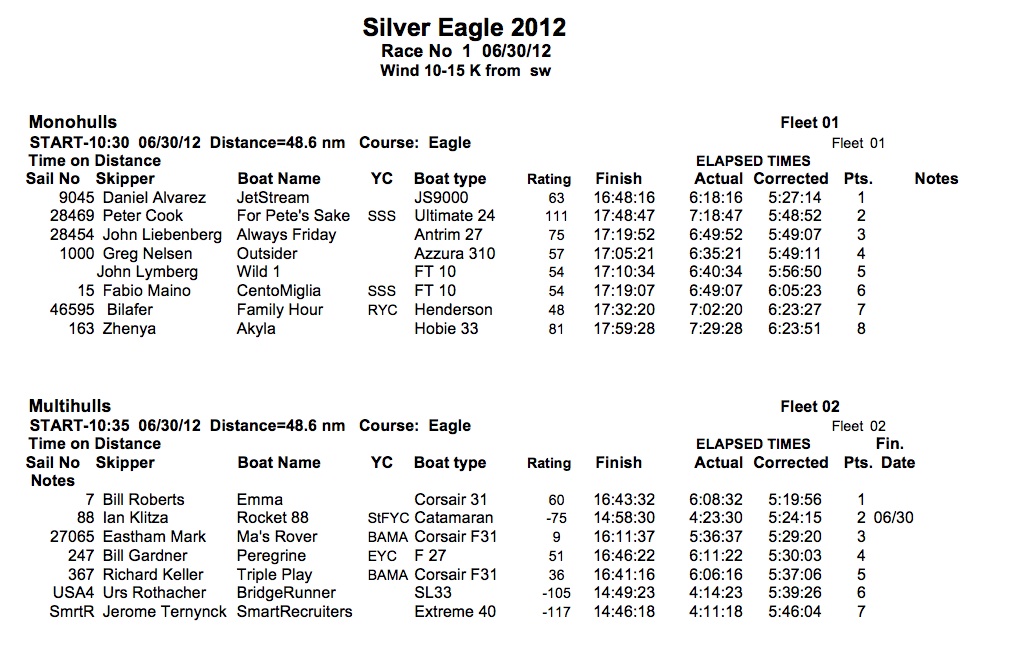
We pulled the plug at TI at around 6:30, If the wind cooperated there was going to be at least another 3 hours of racing, and if it didn't who knows. It was an up and down race. There were multiple races in the race, if I look at them independently we did great, but if you put it all together, well it would have sucked.

Day started with a jammed main halyard, had to pull into the GGYC marina. With a locking main the actual halyard is really small and light and if its breeze and we are not careful it can jump the sheave and jam. Well it was breeze and we weren't careful. Didn't have to climb the mast. If we get a long line (which we now carry) and enough angle on it, we can give it a good pull and pop it out.


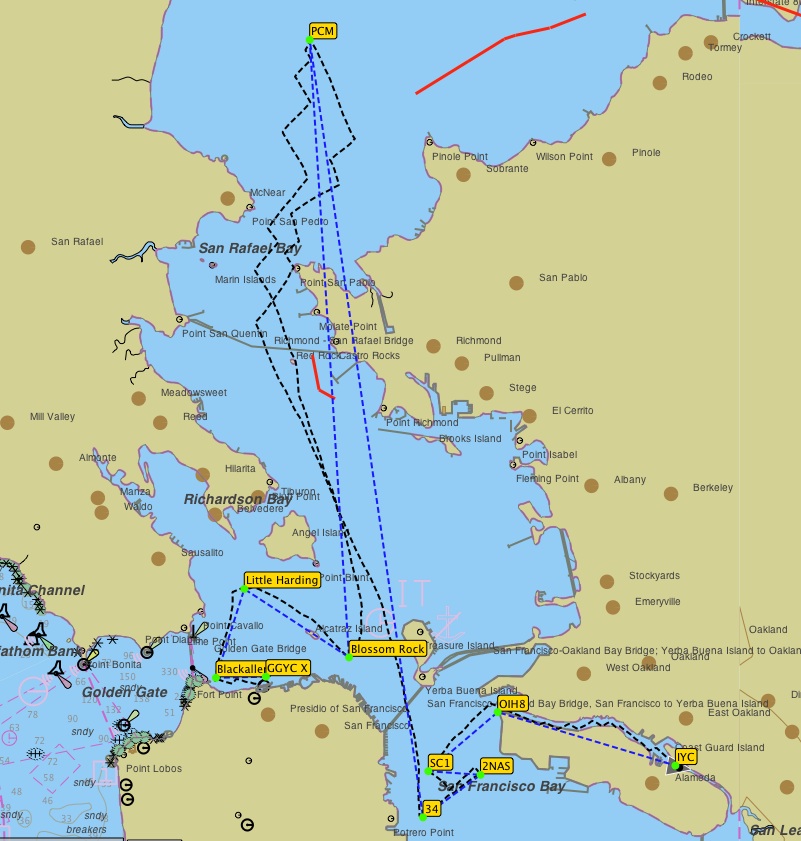
First race, start and central bay: OK start in good pressure. Had to do a couple clearing tacks to get on a good lane. A bit of a too close lee bow by a friendly competitor, way too early in a long race to call for a foul (and we didn't carry our protest flag anyways). Got to the windward mark first closely followed by the Melges 24 (those boats can point). Initially thought the reach to LH would be too tight to set so we had set up for a gibe set at LH, but we had it all wrong. Halfway up to LH we could have set but had everything in the wrong side. Kept high to give us enough room to gibe-set and and gibe back. Good pressure and started separating from the Melges and the FT. Gibed at LH and couldn't make Blossom with the big kite up. Kept on going a little ways to have a better angle to Blossom, dropped and had a fast white sail reach to Blossom. By the time we rounded Blossom we have built a healthy lead. We stayed middle-right to avoid the worst of the lee of Angel Island and as we neared Pt. Blunt we reset the kite to push us further East to try to get around the hole and avoid the remaining ebb. There was to getting around the hole and here we parked it for around 45 minutes, seeing all the folks behind us join us. We had lunch and waited and waited for enough of a breeze to get us to the other side. Kite up, kite down, jib up, jib down, repeat....


The folks on the island side got free first, but it quickly filled in to a let us loose too. We followed the Tiger for a bit and then broke to the right in search of more pressure near the Richmond restricted area. Not sure everyone respected the restricted area, but again, no flag and that one is a bit harder to proof unless you can get the right picture or have some witnesses. We quickly got in the lead again and led the fleet to PCM. Nice cruising conditions, flat water 10 - 12 knots. Good time to let the crew get some driving time. Got to PCM first and started to work our way back. We went right to try to avoid as much of the building flood as possible.


A pleasant upwind leg to the sisters, with the Melges making up some ground on us on the lightish conditions, we had a bit of speed on them but they had 5+ degrees of point on us. Decision time at the Sisters, stay North and try to run the edge of the current or cut across to San Pablo. North seemed a long way around to were we needed to be, so we cut across with the monohull fleet following. But 3/4 of the way to the shallows on the San Pablo side the wind shut down and we got caught in no-mans land. Center channel in a f&*% flood and no breeze. The folks behind saw it and tacked away. Eventually we worked our way to the shallows and short tacked up to San Pablo Pt. Played the cone on the Brothers and gained back some of what we had lost to the Tiger and Melges that were now in front of us. More shore tacking between the piers. While both the Melges and the Tiger continued short tacking up to the bridge, we broke out early and headed to Red Rock, with the eventual goal of getting to the westerlies first. This seemed to pay off. We crossed the Richmond Bridge first and got past Red Rock first. Us on the West side and the Tiger and the Melges on the East. We kept playing the right, but the two breezes were in constant fight right over us with neither dominating. The Melges committed way to the East, we played the West and the Tiger was in the middle. For a while we looked really good, but the Melges got the breeze first and shot off to the lead. Another wind hole around Southampton before we could catch up to the strong westerly in the slot. At this point we were on a tight reach to the West side of TI chasing down the Melges. Solid 20 - 25 knots in the slot, but the long day was wearing down on us.


We almost put the outboard on at the lee of Angel, but the Westerly filled in and we decided to continue racing and re-evaluate at TI. It was past 6 at the time we reached TI and we decided to pull the plug and head to the leeward side of TI towards Alameda. We were still sailing when we crossed the Bay Bridges and what we saw solidified our decision to call it a day. It looked really light on the South Bay. 


Well, that was that, motored down the Estuary, saw the Can and Ghost, ghosting down the Estuary on their way to finish. Hopefully a better run next year. Congrats to the finishers, it was certainly a trying day.

Sunday, March 17, 2013

SSS Corinthian - got Moorified

Courtesy of pressure-drop.us
Saturday proved to be a beautiful day for sailing in the San Francisco Bay.  The SSS Corinthian Race is an 18 mile tour of the central bay.  The race starts off the deck of the Corinthian YC in Tiburon, sends up past Alcatraz and along the San Francisco city front, over towards Richmond to South Hampton Shoals and back around to Tiburon.

Rob joined me for this Doublehanded race.  The race was postponed by 30 mins to wait for the Westerlies to build, and though they made a valiant effort by the time of our start 25 minutes later they had mostly faded away.  We had a clean, good start, but in the light conditions we lost some ground to the better light air boats.  Both the 1D35 stretched ahead and even some the Moore24 with their overlapping genoas managed to beat us to the first mark.  By the time we reached Little Harding the Westerly was building to the mid teens and we had a good screaming reach across the Bay towards Blossom.  We deployed the Code 0 halfway down the reach, once I knew I could clear Alcatraz and we started picking up boats.    I tried twice to get through a couple of boats lees, but that failed both times making us loose a little time.

But by the time we reached Blossom we had passed the Moore's that were ahead of us and where within striking distance of the 1D35s.  Here we split the majority of the fleet headed towards the city front.  It was still early in the flood and we decided to head towards Alcatraz and head to the city front later in the leg.  This payed off, by the time we crossed with the city front group we had significantly shortened the gap.

The tighter fleet resulted in a first for me in over ten years of racing in the SSS, I protested a competitor.    Not that I have anything against calling fouls and throwing a red flag, it is part of the sport and how the rules are enforced.  But the culture of the SSS, given that everyone is sailing shorthanded, is to avoid close situations.  In this particular case one of the 1D35 on port tack failed to give us right of way as the starboard boat.  Attempting this close pass was a bit uncalled for, but fine you try, but the reaction of the other skipper at failing the pass and fouling us was just ridiculous.   Not only did the other skipper did not attempt to avoid us (didn't even bother to change course) resulting in us having to do a crash tack, but later refusing to do his penalty circles and claiming to us later down the course that we had altered course.  Our two boats continued to cross tacks up the city front without further incident, until closer to the windward mark where they again failed to give us right of way as the starboard boat.   At the end of the day they withdrew from the race (DNF), but the protest form was ready to go.

The stress of short tacking up the city front gone, we rounded the windward mark and set the kite towards South Hampton.  We took a quick gybe to take advantage of the stronger pressure on the San Francisco side and that paid hugely.   By the time we got to Alcatraz there were only two monohulls and 2 multihulls ahead of us.  The multihulls we wouldn't see again, those two F-31s were gone, but we caught up to the two monohulls (Q and a J-44)  before reaching South Hampton.  This was some of the nicest sailing I have done in a while.  Sunny, flat water, powered up with 12 - 15 knots of boat speed, without a care.  I could have just kept going.

Now came the big decision, to Racoon-it or not.  You normally can get a better VMG going through Racoon Straits, as long as you can quickly navigate around the wind hole in the lee of Angel Island.  As the first monohull the decision was up to us, though we had seen the two leading multihulls choosing not to go through Racoon.  With a visible windhole and a flood current, we decided to stay in the breeze and go around Angel Island avoiding the Racoon Straits.

We tried to protect our position with the boats behind us, but with the longer waterline the J-44  passed us before Pt Blunt, and Q with its incredible pointing ability was closing the gap rapidly.   We managed to keep Q behind us, but by the time we reached Little Harding again they were only a few boatlengths behind us.

We prepared ourselves for a screaming run to the finish.  Rounder the mark, hoisted the kite and ..... WTF, what is going on, the kite is not filling, the wind is on our nose.  Took us a few seconds to realize  that we are in a massive wind hole.  The whole area between Little Harding and the finish is dead, nada.  We drop the kite get the jib up and try to work the zephyrs.  It is a very delicate breeze and we get into ghosting mode.   With the current in our favor, our main concern is to try to stay upcurrent of the finish line to ensure the current doesn't sweep us past the line without finishing.

I do feel for the guys on the J-44, they were clear ahead of us, maybe 2/3rs from the finish by the time we rounded Little Harding, but in these conditions they were just parked while we were ghosting at around 2 knots and were able to pass them within a couple hundred yards from the finish.  Close to the finish the breeze backed again and we hoisted the kite again and two gybes later we finished the race under spinnaker.

We probably could have hoisted a little earlier, though not clear if that would have covered the time needed to beat the two Moore 24 that got us on corrected time.  We did get the win in our division and were the first monohull to finish, with a respectable 3rd Overall behind the two Moore's that got us.  Great day on JetStream.

Sunday, January 27, 2013

2013 Three Bridge Fiasco

The biggest race in the US.  365 boats entered for this version of the race all racing either single or double handed only, run by the Singlehanded Sailing Society of San Francisco.  There is a lot of anticipation and this year was no different.  Rob will be returning to crew for JetStream.  I spent a bit of time crunching some numbers to see if there was a strategic advantage on which way to run the course. For a Westerly breeze, running the course counter clockwise showed a slight advantage for our start time and the angles our boat likes.  But it wasn't a deal breaker, so conditions at the start would ultimately determine our course strategy.

We made it up to the start area with plenty of time, so tied up to one of the nice new docks at the GGYC and got the boat rigged up for some racing.  On the motor over to the start we could see the breeze was already nicely filled in around Treasure Island at around 10 knots.  On the starting area it was already blowing around 12, and we could also see that there was little to no breeze on the northern side of the bay.  This determined our course for the day, we would go counter clockwise: TI, Red Rock, Blackaller.

We set up for our pursuit style start, set the kite and were off heading towards the middle to take advantage of the remaining flood.  We didn't see too many people follow us choosing to go the other route, but we soon saw the Farr 30 set the kite behind us and we knew the race was on.  We got around TI smoothly and started to work our way North on a tight reach.  Everything was progressing according to plan.  Even better, we could see the folks that went the other way parked at the exit of Raccoon Straits.  Then, we caught up to the fleet ahead of us and the wind hole blocking our path.  The  solid Westerly dissipated around the Berkeley pier.   We could see a wind line on the north and the shore side so we tried to head to that.  The Farr 30 stayed on the west side as they eliminated the lead we had and separated for us.  So now a waiting game to see who will get the new breeze first.

The first sign of the bad things to come was seeing the guys on Raccoon take off on a new NW breeze.    That wouldn't bade well for us going CCwise.  It will transform the TI to Red Rock race from a beam and broad reach to an upwind leg.  While the clockwise folks would get a dream downwind run.  Our only hope at this point was for the clockwise folks to find a wind hole around TI.  But that didn't happen.  In any case, we still had a race in our hands with the folks going CCwise with us.  The Farr 30 and Farr 36 both got ahead and rounded Red Rock ahead of us.    At least, we could bare away and set our kite again.  In our rush to get up and going I called for the setting of the A2.  Had I thought about it for a second or two, I would have probably realized that it was a pretty tight reach and the A5 would have been a better call.  But we set the kite and started reeling in boats, passing the Farr 36 and gaining some back on the Farr 30.  We couldn't hold the angle to Raccoon Straits and were forced to drop the kite halfway down the leg.

The entrance to Raccoon Straits delivered on our own personal, special gift.  Our own private wind hole.  Even though we were following the line of the Farr 30 in front of us, we magically ran into a wind hole that had plenty of breeze just a few minutes before.   I lost my cool momentarily as folks behind us, particularly the Farr36 tacking the corner tight, squeezed by in better current and just got away.  After a frustrating beat through the Straits we finally punched in to the breeze and the reach across the Bay to Blackaller.   We were reveling in the now breeze conditions on a white sail reach.    We caught up with a few Moore 24s in front of us and got to the mark around some boats.  A bit too congested for the conditions.

This time we set the right sail as it was now blowing 25+.  A couple close encounters in challenging conditions while jibing down the city front.  A hundred yards or so from the finish line we blew the vang during a jibe, but managed to keep things together (most importantly the rig) through the finished. We quickly dropped the kite and jury rigged the vang to get us safely home.  Finished a little after 1:40, on course for less than 3.5 hours in a beautiful January day in San Francisco Bay.    We didn't get the results we had hoped for but were pretty satisfied with the performance.

The results are still not in, so hard to tell how far back from the leaders we ended up.  We also had some GoPros on board so there should be some footage in the near future.  Look for updates here.

Here is our non-winning course (counter clockwise):
JetStream's 2013 counter clockwise track

Sunday, August 5, 2012

2nd Half Opener

This year's 2nd Half Opener provided great conditions for JetStream.  With Rob and Andrew as crew we set out to defend our win from last year.  We hung in there for the upwind leg to Pt Bonita and then let the boat do its thing for the run down to Encinal Yacht Club.

Here is another great video production from Rob.


Sunday, July 1, 2012

2012 Silver Eagle

The Silver Eagle is an inside the Bay 50+ mile race.   It is the first time I do it and the first outing for JetStream.  It should be a favorable race for us as it has plenty of reaching and downwind legs as we criss cross our way around the Bay.


The regular crew of Andrew and Rob were out for the race as well.  The top move of the day was Rob perfectly executing a body drag.  He had previously threatened with a scuba diver back roll, but this time he would execute what I will call the 'Rob Swing'.  From the leeward rail, enter the water with your feet towards the bow.  Making sure the boat is traveling in excess of 8 knots, while maintaining a strong grip on whatever is available, submerge yourself chest deep.  The force of the water will swing your legs under you and back towards the stern of the boat with sufficient force to enable you to get one leg over the rail.  If you are strong enough to hang on and any of the crew is willing to lend a hand you will be back on the boat in less than 5 seconds, fully refreshed and without slowing the boat much.


Back to racing... 


The day started with a bit of a rush with only minutes to spare to make it to the warning signal on time.  Decent breeze at the start.  We started with our new #4 for the short upwind leg to Blackaller.  We played the shore side tightly and were the first mono to round, one of the big cats had passed us already.  We immediately set our A2 for the run to Little Harding (there was a bit of South in the breeze) and we stretched away from the rest of the monohull fleet.  By the time we hit Little Harding all the big three cats had screamed right past even with us doing low to mid teens.  The cats were flying.

We couldn't hold the kite on the leg from Little Harding to Blossom, and in a rushed douse shrimped it momentarily.  So we white sailed reached to the mark.  We rounded and set up our Code 0 to try to stay high and in the favorable current.  We stretched a little more with Outsider and Wild 1 chasing behind.  We had to go back to white sails as the wind increased a bit through the slot., but past Angel Island it was back to the A2 for the downwind run to the Petaluma Channel.  The wind lightened up a bit and we started getting a bit concerned with Outsider and Wild1.   We  ended up cutting the lee of Red Rock too close and gave some of the lead up.  On the remainder of the run in 12 - 15 we managed to stay in front of Outsider.

On the way back up San Pablo Bay we headed to the deep water for the beginning of the ebb.  We mostly did a loose cover on the boats behind us and built up our lead.  It was a very pleasant upwind leg with the sun out and enough breeze to fully power up the boat, now with the full jib up.  We played the right hand side after the Brothers and that paid huge while Outsider and Wild 1 stayed on the Richmond side.  We were able to crack off early on our way to TI.  With not much of a wind hole behind Angel Island we were able to go across West of the Southampton shoals with plenty of breeze as we entered the slot.  It was probably low to mid 20s with a decent chop from the ebb.
We had a couple of trimaran pass us in this leg, they were fully powered on and moving fast.

We stayed relatively close to TI as the ebb was now building.  We had plenty of breeze as we made our way to mark 34 in the South Bay.  Set our A5 for the run to 2NAS, by this point we had built a decent lead.  As we were making our way back to SC1 we could see both Outsider and Wild1 setting kites as they rounded 34.  Another A2 set for the run to and down the Estuary.  Really nice breeze as well down the Estuary, almost caught back a few of the tris in front of us.  Didn't catch the tris, but still good for the monohull gun.


Great day out on the water, a little sore today.